
Austerity Is a Sound Bite. Inflation Is the Plan.
Past a certain size, a state cannot tighten its belt. Inflation is the only way out.
The Kitchen Table
A family in Ohio earns $100 a month. Rates go up, the mortgage resets, the grocery bill climbs, and one month the outgoings reach $110. The husband and wife sit down at the kitchen table, go through the list, and find $10 to cut. The budget balances. Life goes on.
It works for one reason, so obvious that nobody says it: the family’s income does not depend on its spending. The employer does not pay the husband less because the family stopped eating out. This is the story every politician tells when he sells austerity. For a sovereign, it is wrong. A state’s income and its spending are the same ledger.
Where the State’s $5.2 Trillion Comes From
In fiscal 2025 Washington collected $5.2 trillion and spent $7.0 trillion. The receipts come from five buckets. The question that matters is which of them falls when the Dow falls.
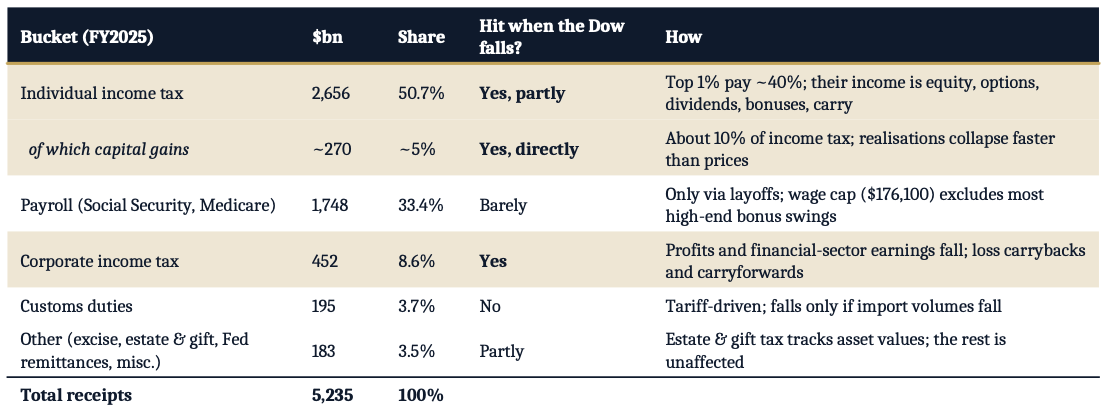
Exhibit 1 · Where the $5.2 trillion comes from, and what a falling market does to it.
Sources: CBO Monthly Budget Review, FY2025; capital gains from CBO 2025 projection via Peter G. Peterson Foundation; top-1% share from IRS Statistics of Income. Capital gains are part of individual income tax, not additional to it.
Capital gains on their own are about $270 billion, a tenth of the income tax. But the exposure is much wider. The top 1% of filers pay about 40% of all income tax, and their income is equity, options, dividends, bonuses and carried interest. Add corporate and estate tax, and roughly $0.7 to $1.0 trillion of federal receipts moves with the stock market. The US Treasury is, in effect, long the S&P 500.
Now Cut $2 Trillion
To bring spending down to 2025’s income, Washington must cut $2 trillion, nearly 30% of outlays. But $1 trillion of those outlays is interest on the debt, and interest cannot be cut. So the $2 trillion has to come out of the remaining $6 trillion: one dollar in every three of Social Security, Medicare, Medicaid, defence and everything else.
Follow the money. Federal spending is 23% of GDP, and every dollar of it is someone’s income. Pull a third of it out and hospitals, contractors and agencies lay people off. Laid-off workers pay less income and payroll tax, and they claim unemployment benefits.
Now add the other half of the orthodox cure: high interest rates. High rates and a shrinking economy pull money out of equities. The market falls, capital gains collapse (realised gains fell about 70% in 2007–09), and corporate tax follows profits down.
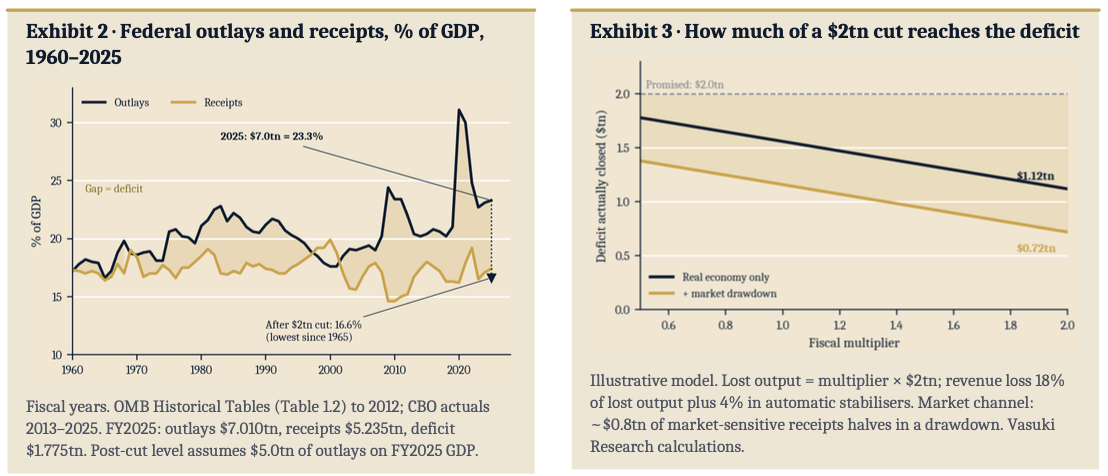
Exhibit 2 · How much of the proposed $2 trillion spending cut reaches the deficit.
Spending falls by $2 trillion. Receipts fall behind it. Of the promised saving, only $0.7 to $1.4 trillion survives. The gap narrows a little, and the economy is far smaller. With GDP down perhaps 10%, the debt ratio jumps rather than falls. The problem is not the size of the spending. It is the gap between spending and income, and when the income is made of the spending, cutting one drags the other down with it.
The Sound Bite and the Truth
Politicians do not miss this. They know it. When a candidate promises to “cut waste” and “live within our means”, he is borrowing the logic of the kitchen table because it resonates with every family that has ever balanced a budget. It is a sound bite built to feel true, delivered by people who know it is not. No finance ministry expects a 30% cut to close the deficit by 30%. They just never say so.
The Ratchet
It may sound conspiratorial, but it is closer to arithmetic. Every rise in the state’s share of the economy creates more voters who depend on it: pensioners, public employees, contractors, recipients of every subsidy and transfer. Each is a vote against cutting. And every rise makes the state’s revenue more dependent on its own spending. Wars, depressions, 2008 and COVID each pushed the share up. Almost none of it came back down.
There is a threshold. When the state spends less than about 30% of GDP, it can still tighten. A cut leaves most incomes, and most of the tax base, untouched.
Between 30% and 40%, every cut starts to eat its own revenue, and the voters who depend on the state are numerous enough to swing elections. Belt-tightening becomes difficult.
Near 50%, half the economy runs through the state. A cut is a cut to every second pay cheque, and the tax base shrinks almost as fast as the spending. Belt-tightening becomes close to impossible.
The US has crossed 40%. The UK sits near 50%. France is well past it.
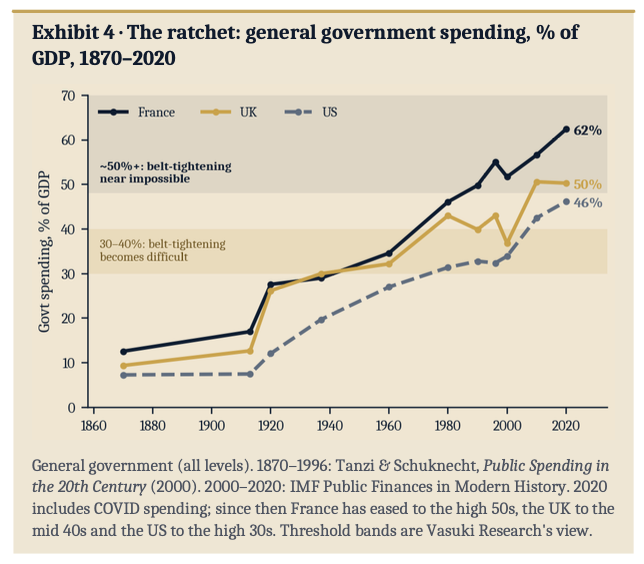
Exhibit 3 · The long-run rise in the state’s share of the economy.
Past that point, the state becomes a perpetual vote-making machine, and it runs until the currency or the bond market stops it.
Inflation Is Not a Risk. It Is the Exit.
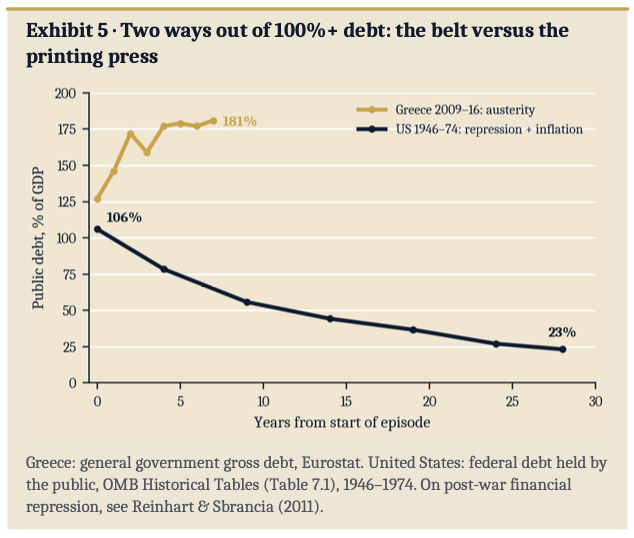
Greece tried the kitchen table. From 2009 to 2016 it cut pensions, wages and public jobs, and raised taxes. Its nominal debt barely moved, from about €300 billion to €318 billion, even after the largest sovereign haircut in history. Yet its debt ratio rose from 127% to 181% of GDP, because nominal GDP fell by a quarter. Austerity succeeded in cutting spending, and the economy went with it.
America took the other road. It came out of the war with debt at 106% of GDP and never repaid a dollar; nominal debt actually rose. Yields were capped by the Fed until 1951, real rates were held below zero, and inflation and growth did the rest. By 1974 the ratio was 23%.
Greece took the belt. America took the printing press. Only one of them got out.
The debt crisis of the West will not be resolved by tightening. The US, the UK and France all carry debt near or above 100% of GDP, with states that spend 40% to 60% of the economy. For them, austerity shrinks the tax base faster than it shrinks the deficit, and the voters who depend on the state will not allow it anyway. US gross federal debt is now about 1.2 times GDP.
That leaves one exit: hold interest rates below inflation, let inflation run hot, and grow nominal GDP faster than the debt. Savers earn negative real returns, asset prices rise, capital-gains receipts swell, and indexed obligations quietly shrink in real terms whenever official CPI trails the cost of living. Inflation is not a risk to be managed. It is the policy, and it is inevitable.
Nobody votes for debasement, so it will never be announced. It will arrive as “temporary” rate cuts, yield caps and official inflation that runs below what families actually pay. The debt will not be repaid. It will be inflated away, and the bill will go to anyone holding cash or bonds: the same Ohio family, still cutting at the kitchen table.
A household that cuts its spending saves itself.
A state that cuts its spending cuts its own income.