
The Currency Doesn’t.
Debasement is not a policy mistake.
It is a one-way door.
History offers no example of a seriously debased currency recovering both its former value and the trust it once commanded.
Governments can change laws, issue new notes, promise discipline. What they cannot do is legislate trust back into existence. When confidence dies, the currency dies — and usually the state that issued it goes with it.
America is betting it can be the exception.
Why It Always Happens
Debasement is never an accident. It is the decision of someone who holds office for four or five years and owns a problem he cannot actually solve.
Cutting Social Security is politically fatal. Raising taxes is painful today. Default is instant catastrophe. Debasement is the one lever whose cost lands on someone else’s term, not his — and voters, who do not want to hear that the bill has come due, reward the politician who appears to have found a way around paying it.
No conspiracy is required. Only a short enough tenure, a long enough runway, and a population that would rather be told a comfortable story.
The Point of No Return
U.S. government debt is already about 1.2 times the size of the entire economy, heading toward 1.4 times within five years on the IMF’s own projections — and the gap is widening fast because tax receipts are rising far more slowly than the government’s spending obligations.
The signal is already visible in the budget itself: net interest on the debt hit $970 billion in FY2025, overtaking defense spending, and now trails only Social Security and Medicare as a line item.
Add interest to mandatory spending on Social Security, Medicare, Medicaid and other entitlements — together roughly $5.2 trillion — and it is almost exactly what Washington collected in total revenue that year.
Defense and everything else the government does was funded entirely by new borrowing.
History has one answer for what happens once a country crosses this line: the currency dies.
It is hard to construct a plausible scenario in which the dollar, as it exists today, comes through this intact.
Why 1946 Is Not a Precedent
The only other time debt ran this high was 1946, coming out of World War II, when debt held by the public peaked near 106% of GDP.
But that debt was a one-time hump from a war that had just ended — serviced by interest rates the Federal Reserve pinned artificially low, and paid down by a decade of extraordinary post-war growth and a baby boom that swelled the tax base.
Today’s debt is not a one-time hump. It is a structurally rising line, driven by an aging population and healthcare costs that grow faster than the economy, financed at real market interest rates no central bank is holding down.
What worked in 1946 is not available in 2026.
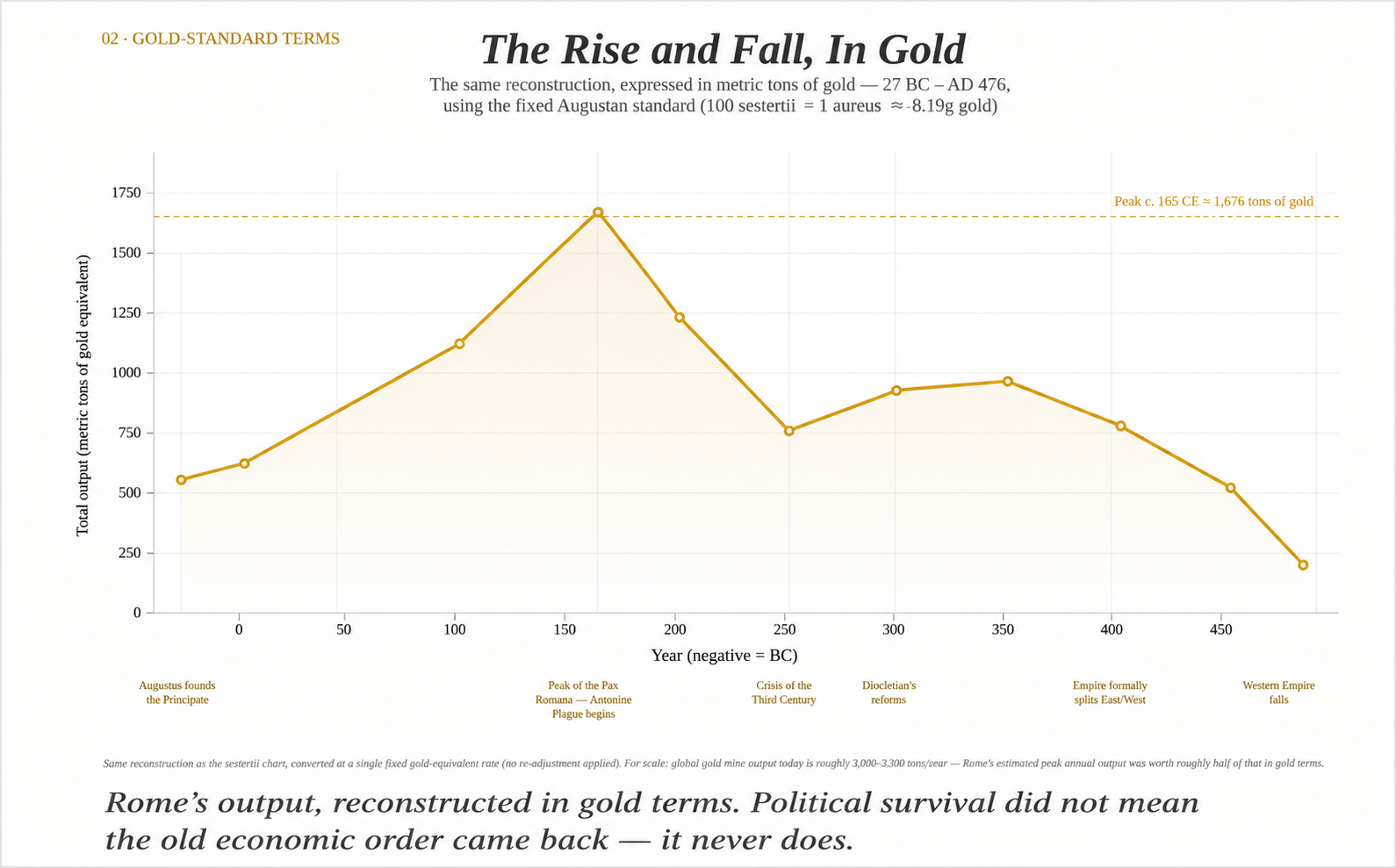
The Exception — And Why It’s Harder Now
Two states survived the death of their own currency, and both did it the same way: they did not repair the old money, they replaced it with a new one backed by gold.
In 312 CE, Constantine introduced the solidus — a coin of fixed weight, about 4.5 grams, struck at 72 to the Roman pound, and kept almost pure gold by a state that had rebuilt its ability to tax and extract resources.
The solidus replaced the old, ruined silver coinage outright, and held its value for centuries.
Britain took the same road after the Napoleonic Wars: it suspended gold convertibility in 1797, spent years rebuilding reserves through trade and industry, and only in 1821 relinked the pound to gold — at painful cost.
The money supply contracted by roughly a third; prices and wages fell for the better part of a decade. The modern equivalent would be a recession deeper than 2008, sustained for years, not quarters.
Rome and Britain could inflict that pain because the people bearing it had no real power to remove the people imposing it.
The United States in 2026 does not have that luxury — a new, gold-backed dollar demands the same order of sacrifice, imposed on a fully enfranchised electorate that can vote out whoever asks for it, every two years, before the job is done.
There is a second difference. Rome had tribes to manage but no peer empire contesting its position. Britain relinked the pound against a Europe left exhausted by Napoleon, with no rival positioned to contest its supremacy.
The United States has no such room.
China has serious problems of its own — a property crisis, a shrinking workforce, a financial system its own regulators do not fully trust — but it does not need to be healthy to be a counterweight, only present.
And it has been acting like one: Beijing has cut its Treasury holdings roughly in half since 2013, from over $1.3 trillion to under $700 billion, while its central bank has bought gold for seventeen straight months running.
Much of the demand that used to come from foreign governments recycling trade surpluses is now being replaced by hedge funds and custody flows through hubs like London — a far less patient source of demand.
A smooth, uncontested handoff to a new dollar, the way Rome and Britain managed theirs, assumes a level of breathing room that does not exist this time.
The Reserve-Currency Trap
There is a bind hiding underneath all of this.
Keeping the dollar as the world’s reserve currency has meant running large trade deficits for decades — the rest of the world needs a steady outflow of dollars to hold as reserves, and America supplied them partly by importing more than it exported, hollowing out its own manufacturing base in the process, much of it to China.
Washington is now trying to reverse that: reshoring factories, restricting exports, rebuilding domestic supply chains.
But a country cannot run a large trade surplus and still be the reserve currency supplying the world with dollars.
Industrial independence and reserve-currency status pull in different directions, and a monetary order built to resolve that tension is unlikely to be today’s dollar.
Everyone Owns Everyone Else
This is not only an American disease, and it is not only a dollar problem.
On IMF numbers, Japan carries debt at 204% of GDP, Italy 138%, Greece 137%, France 118% — fifteen major economies now sit above the 100% line, nearly all of them still climbing.
Rome’s monetary crisis stayed Rome’s: no foreign treasury held Roman bonds.
Today, one sovereign’s liability sits on another sovereign’s balance sheet as its reserve asset.
Japan alone holds roughly $1.12 trillion of U.S. Treasuries while carrying a heavy debt load of its own.
Debase the dollar and Washington is not only cutting an American liability — it is gutting someone else’s reserve asset, forcing their own currency response, which loops straight back into the dollar.
There is no historical precedent for this part.
The idea that one sovereign’s monetary collapse gets absorbed through a web of other states holding its debt as its own reserve asset has never been tested, at this scale, in this form, before.
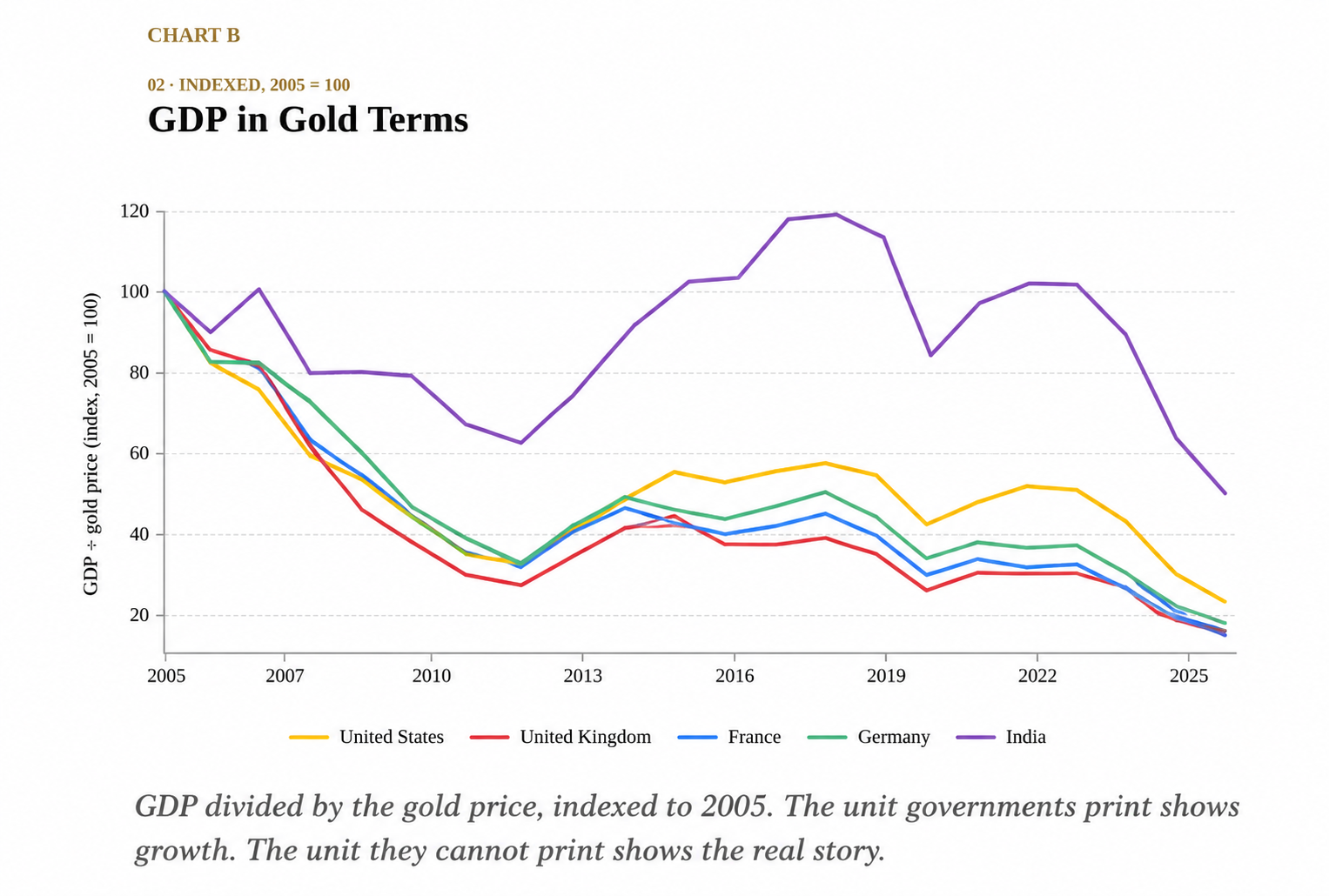
A simultaneous repricing of sovereign balance sheets against one another — transmitted through reserves, government bonds, banks and capital markets, at a speed no earlier monetary collapse ever had to survive.
The Endgame
America will probably survive this. The dollar, as it exists today, probably will not — it is hard to construct a plausible scenario where it comes through intact.
Debt-to-GDP is already past the point history says a currency can carry, it is rising fast, and no country has ever brought a debased currency back from that line.
What replaces the dollar will need to be backed by something no government can print — history’s answer has always been gold, and Rome and Britain both show what that transition actually costs: years of real, imposed pain.
All of this sits on top of a global system where every major economy now holds pieces of America’s balance sheet as its own reserve asset, and a rival power stands ready to make the transition anything but smooth.
This is not a forecast with a comfortable ending.
It is a bet that the state outlives its currency — and a warning that the world goes through the pain together this time, not alone.
Build your balance sheet as if the answer is genuinely uncertain — because it is.
The Numbers, In Short
The Threshold
Debt is already 1.2x GDP and rising toward 1.4x by 2031 on IMF numbers. Interest on the debt ($970bn) now exceeds defense spending. Interest plus entitlements alone consume nearly all federal revenue.
The Playbook
Rome (312 CE) and Britain (1821) both survived by replacing the old currency with a new one backed by gold, at years of real cost. Expect the same shape here.
The Twist
Rome and Britain both transitioned with no peer rival and no one else holding their debt. Today China is a genuine counterweight, and the rest of the world holds the dollar as its own reserve asset. Neither precedent applies cleanly.
Sources & Disclaimer
Fiscal figures: Congressional Budget Office, Budget and Economic Outlook 2026–2036; U.S. Treasury Fiscal Data, net interest and mandatory spending, FY2025.
Debt-to-GDP: IMF World Economic Outlook, April 2026.
Treasury holdings: U.S. Treasury TIC data, 2026.
This note reflects the author’s opinion.