
GETTING OFF THE TIGER
The point in one line. If the U.S., U.K. or Italy had to carry their existing debt at 1970–85 bond rates, interest alone would absorb between 43% and 56% of everything the state collects. Raising rates is no longer a credible way for these countries to fight inflation. Central banks will need a different playbook.
The textbook answer to inflation is higher interest rates: dearer credit cools demand and lets prices recalibrate. It worked in the late 1970s and early 1980s because governments then owed relatively little.
When debt approaches or exceeds GDP, every extra point of interest becomes a large bill that the state itself must pay.
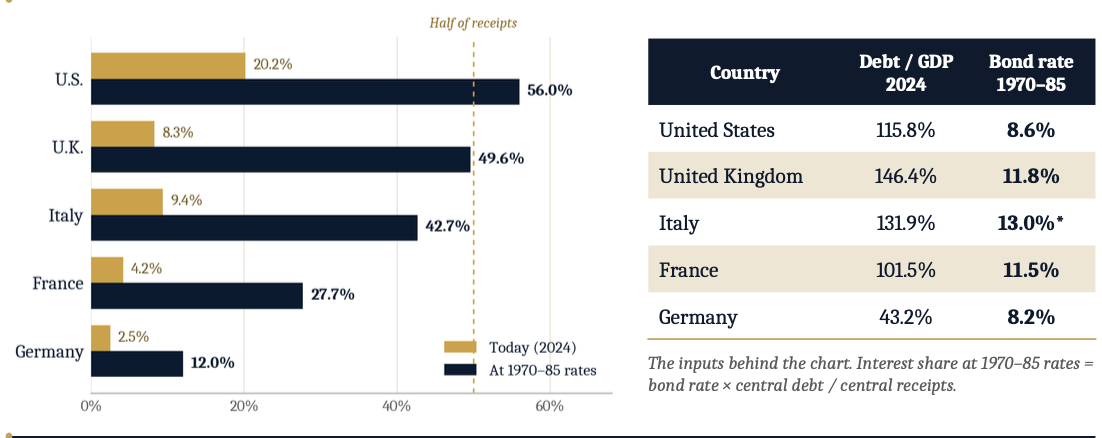
A sustained 1970s-style rate response would push interest toward 56% of U.S. receipts, 50% of U.K. receipts and 43% of Italy’s.
No democracy can hold that line for long without deep spending cuts, sharply higher taxes or still more borrowing, and more borrowing at higher rates feeds the very problem it is meant to solve. Germany, with debt at 43% of GDP, is the exception that proves the rule.
If central banks in high-debt economies are serious about inflation, they will have to think creatively and look beyond the policy rate: balance-sheet management, credit and macroprudential controls, managing the yield curve and, quietly, a greater tolerance of inflation than their mandates admit.
These numbers are an illustration, not a forecast. Their purpose is to show that a sustained rise in interest rates is not a sustainable option.
The simplification cuts both ways. On one side, the entire debt stock would not reprice to higher rates overnight; fixed-rate debt rolls over gradually. On the other, the denominator is held constant, and that flatters the result.
At 1970–85 rates, stock markets would likely fall sharply and capital-gains tax receipts would drop dramatically. Bonus and stock-option pay, and the income tax it generates, would shrink with them, while lower economic activity erodes the rest of the tax base.Receipts would melt away just as the interest bill rises, so the true burden would likely be worse than shown.
Illustrative 2024 central-government comparison. Hypothetical interest / receipts = historic rate × central debt / annual central receipts.
Historic rates are averages of annual long-term government bond yields for 1970–85 (OECD series via FRED: U.S., U.K., France, Germany). Italy 13% is an indicative historical assumption because a comparable full-period series is unavailable.
Debt: World Bank–IMF Quarterly Public Sector Debt, Q4 2024.
Interest and receipts: World Bank / IMF Government Finance Statistics, 2024 (GC.XPN.INTP.RV.ZS and GC.REV.XGRT.GD.ZS).
Receipts include taxes, social contributions and other revenue; national perimeters differ.