
INDIA IS SPENDING ITS WAY INTO A FISCAL TRAP
Democracy, immediate gratification, and the arithmetic of a weakening currency
India is a near-perfect contemporary illustration of the proposition commonly associated with Alexander Fraser Tytler: once voters learn that they can vote themselves benefits from the public treasury, politicians have every incentive to oblige them.
The mechanism is simple. Delayed gratification is politically difficult. A subsidy, transfer or freebie is immediate, visible and personal. The cost arrives later through future budgets, accumulated debt, interest and ultimately the purchasing power of the currency. Voters prefer the benefit today; politicians promise it today; tomorrow’s government inherits the bill.
For the Indian investor, this is the operating environment, not a passing backdrop. A state that keeps expanding its claim on the economy while the currency keeps losing ground turns every decision into a two-front battle — market risk, and the quieter risk of what the rupee will actually be worth by the time returns are realised.
A nominal gain that lags gold or a harder currency is not a real, risk-adjusted return.
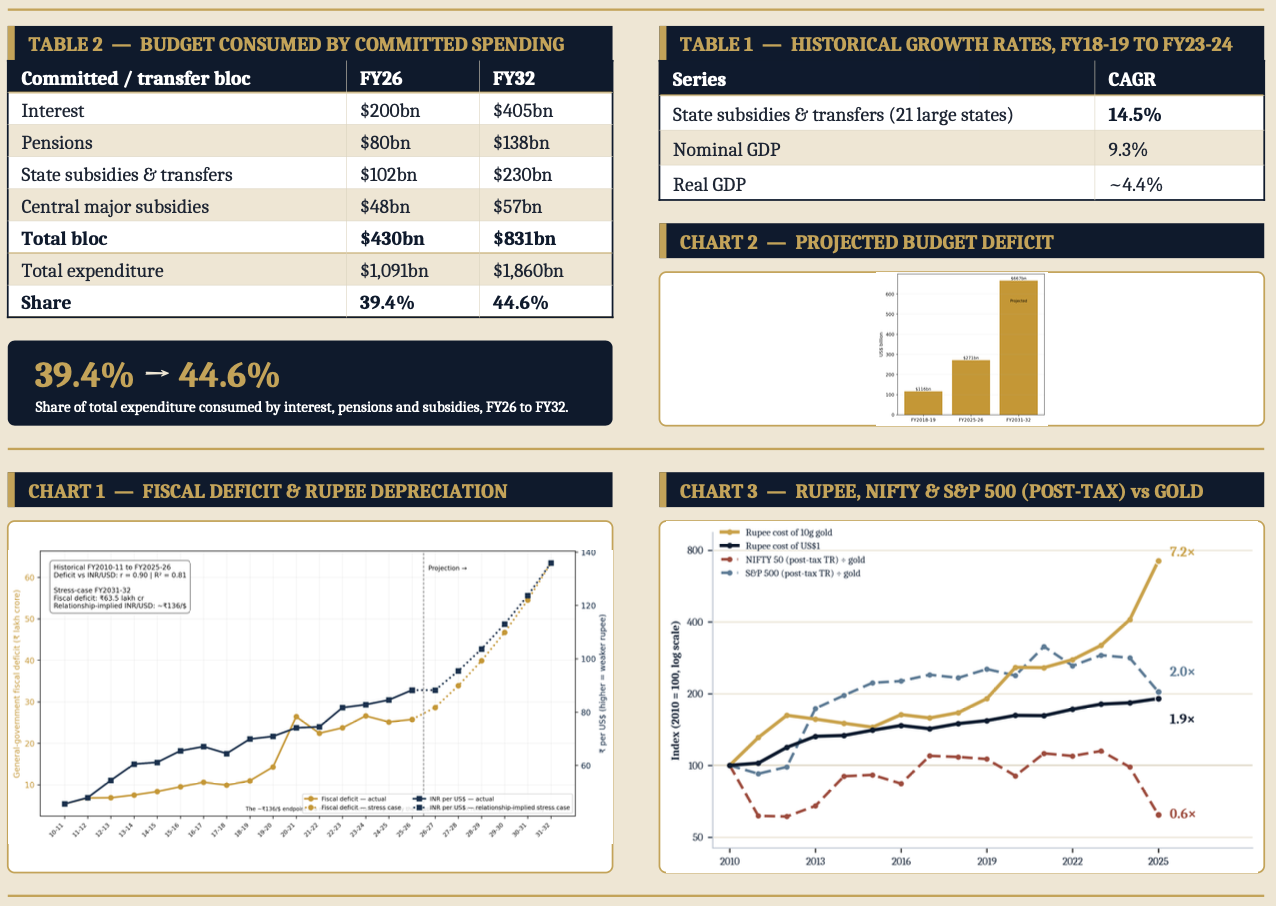
If these fiscal dynamics persist, the rupee will continue to depreciate — getting closer to Rs.150 to the US dollar, at least.
That is the hidden cost of immediate gratification. The freebie is visible. The future tax bill is not. The transfer arrives today. The interest burden accumulates quietly.
Currency depreciation does not arrive with a government invoice, yet it can ultimately redistribute purchasing power just as effectively as a tax.
The warning is therefore not that every subsidy is wrong. It is that a political system which continually rewards present consumption while postponing its financing eventually runs into arithmetic.
Delayed costs do not cease to exist merely because voters cannot see them today.
Methodology
Historical series through FY2025-26. Fiscal deficit vs INR/US$: Pearson r ≈ 0.90; R² ≈ 0.81.
Fiscal path to FY2031-32 is a mechanical stress case; principal accumulates while interest is serviced.
Chart 3 indexes calendar-year INR/US$ and 24K gold (10g, India retail/LBMA) to 2010 = 100.
NIFTY 50 / S&P 500 lines are total-return (price plus dividends, ~1.3%/yr and ~1.9%/yr assumed), post-tax at a blended ~16.5% avg. short+long-term capital gains rate on the cumulative gain only, then divided by the respective gold price.
Sources: Economic Survey of India; RBI; World Bank; MoSPI; Sixteenth Finance Commission; NSE; S&P Dow Jones Indices; India retail gold data.
Forward values are analytical projections, not official forecasts.
If the rupee keeps weakening while fiscal commitments keep expanding, what will your returns actually be worth?
Sources & Disclaimer
Sources: Economic Survey of India; Reserve Bank of India; World Bank; Ministry of Statistics and Programme Implementation; Sixteenth Finance Commission; NSE; S&P Dow Jones Indices; India retail gold data.
The fiscal path and forward values presented in this article are analytical stress-case projections and are not official forecasts. The article reflects the author’s opinion and should not be interpreted as financial, political or investment advice.