
Taxation Isn’t For You.
It’s For Their Reelection.
Taxation increasingly facilitates the re-election of politicians — not the welfare of citizens.
The tax system is usually presented as a mechanism for funding the things citizens need. But taxation also creates something politically valuable: constituencies that depend on government spending.
The more money governments collect, the more money they can redistribute. The more they redistribute, the more people become financially connected to the state.
And once those beneficiaries exist, reducing the spending becomes politically difficult — even when the original justification for it has disappeared.
The Sale
Every tax rise is sold in the language of citizen welfare — better schools, better hospitals, safer streets, stronger infrastructure.
The implicit promise is simple: more state, funded by more tax, buys more security and stability.
Underneath, taxation is used to manufacture clientele — identifying pockets that can be satisfied with largesse — while the spending is marketed as welfare.
The Test
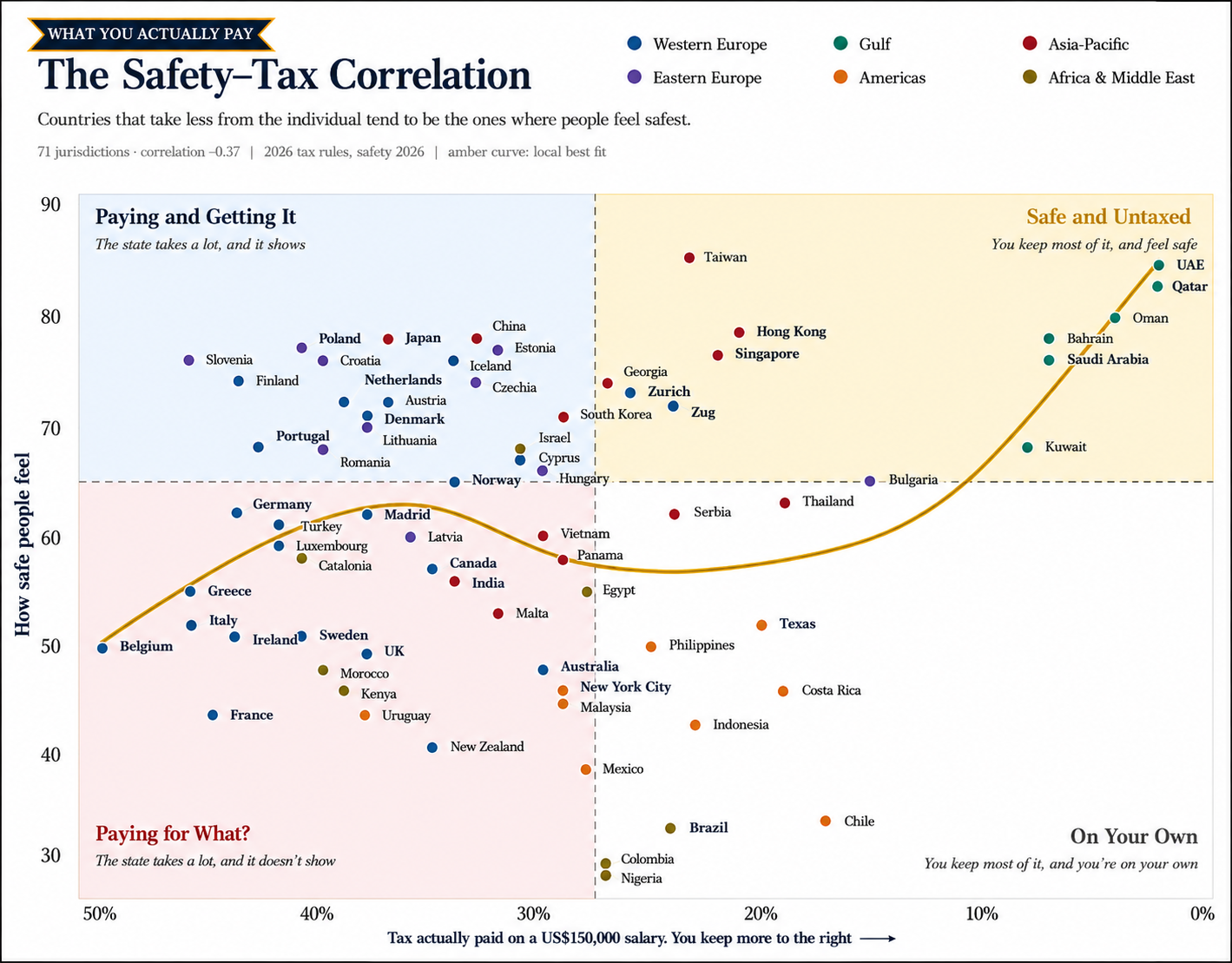
Across 71 jurisdictions, what a $150,000 earner actually pays and how safe people say they feel move in opposite directions — a correlation of −0.37.
Across 71 jurisdictions
If the welfare story held, that number should run positive, not negative.
The Dispersion
The UAE, Qatar and Oman tax almost nothing and rank among the safest places on earth.
Zug and Zurich, same country, sit seven points apart on safety; Texas and New York City, nine.
Where you live inside a country can matter as much as which country you choose.
Local governance, not aggregate tax take, is doing the work.
The Real Mechanism
Governments don’t only tax to fund what citizens need; they spend to create beneficiaries — subsidies, pensions, public payrolls, transfers.
Every beneficiary is a future vote.
The constituency protects the politician who built it.
The Ratchet
Withdrawing a benefit costs votes today; its economic cost is diffuse and arrives later.
So spending outlives the problem that justified it.
And tax rises to fund yesterday’s constituencies more often than tomorrow’s needs.
The Question This Leaves You With
Perhaps the tax bill says less about what you need from the state, and more about what the state — and the politician signing your budget — needs from you.
Consent. Quiescence.
And a reason to vote for the incumbent again.
The Argument, In Short
The Sale
Tax increases are framed as welfare, but the spending creates constituencies that become politically difficult to remove.
The Test
Across 71 jurisdictions, the relationship between the tax burden on a $150,000 earner and perceived safety is negative at −0.37.
The Mechanism
Subsidies, pensions, public payrolls and transfers create beneficiaries — and beneficiaries create political constituencies.
The Ratchet
Benefits are politically easy to create and difficult to remove, allowing spending and taxation to persist long after the original justification has faded.
Sources & Disclaimer
The statistical claims and jurisdiction-level comparisons reflect the analysis underlying this article.
This note reflects the author’s opinion and should not be interpreted as financial, political or investment advice.