
The China Imperative Indias Race Against Time
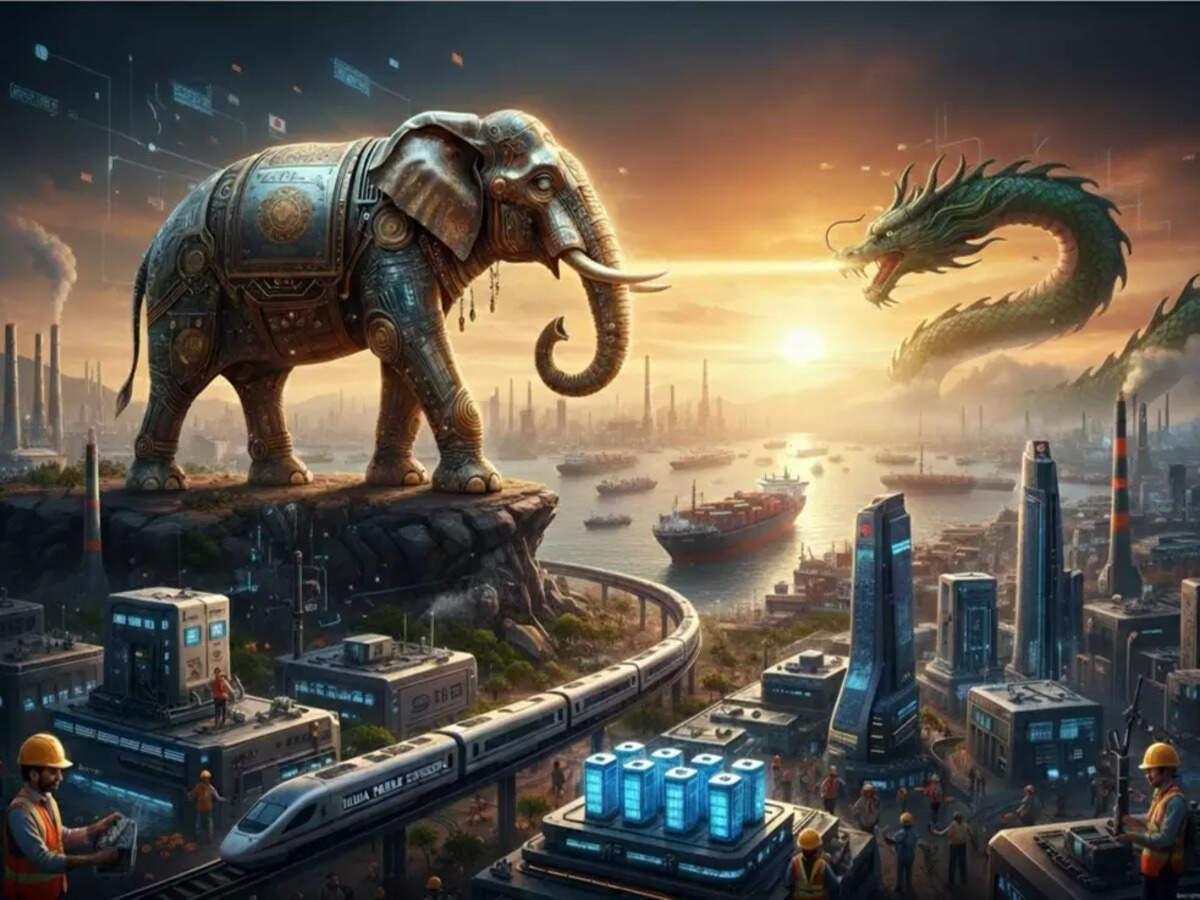
Why factories, not handouts, will decide India’s future.
While India promises ₹15,000 crore in welfare handouts, China quietly builds 500 factories per month. One country is spending on votes. The other is building power.
The gap is widening—and it is not just about money. It is about factories, technology, energy security, and industrial depth. Every year India delays industrial investment, China adds more factories, more research labs, and more supply chains that the world will rely on for decades.
This is not a drill. Political handouts may win elections. But factories win wars, build independence, and secure futures. India’s race is not just economic—it is existential. And time is already running out.
Factories, Not Votes
India’s industrial base remains shallow. Manufacturing contributes roughly 15–17% of GDP, compared with 30–35% in China. Research and development is similarly lagging: India spends 0.8–1% of GDP, China 2–2.5% (note: of a base that’s 5x that of India)
Energy infrastructure is unreliable. Logistics remain fragmented. Ports, rail networks, and power grids are far behind global standards. The result: India cannot scale production in critical sectors like electronics, electric vehicles, shipbuilding, or industrial machinery. Meanwhile, China builds the factories that supply the entire world.
Every year India dithers, China compounds its advantage. This is the arithmetic of power. Factories, supply chains, and energy security do not wait for elections.
The Cost of Welfare Politics
Meanwhile, electoral politics reward short-term spending. Cash transfers, subsidies, and schemes like Ladli Behna multiply across states. The annual cost of these programs runs into tens of thousands of crores, often funded by borrowing.
Borrowing for consumption is easy. Borrowing for capital is hard. But it is the hard choices that determine national destiny. Every rupee spent on welfare programs is a rupee not invested in a factory, a research lab, or an industrial corridor.
India’s fiscal numbers tell a worrying story: combined central and state debt is now 85–90% of GDP, with interest payments consuming over 23% of government revenues—more than defense spending. This is debt funding short-term happiness, while long-term power erodes silently.
Geopolitics Is Unforgiving
India shares a long and contested frontier with China, whose economy is roughly $20+ trillion—nearly five times India’s $4+trillion. China produces three times more manufactured goods, spends four times as much on R&D, and dominates high-tech industrial sectors from electronics to EVs to shipbuilding.
Economic scale is not abstract. It translates directly into military capability, technological dominance, and strategic leverage. Dominant powers rarely tolerate rising neighbors unchecked. Every month India delays industrialization, China widens the gap.
Historical benchmarks suggest that for India to remain strategically autonomous, it must eventually reach 40–60% of China’s GDP. Today, India sits closer to 20%. Below that threshold, sovereignty becomes increasingly theoretical. At best, India risks becoming a quasi-vassal—formally independent, but structurally constrained.
Lessons from History
History is merciless. The Ming Dynasty in China collapsed when fiscal mismanagement and subsidies undermined industrial and military capacity. Short-term generosity calmed the population but hollowed out power. Within decades, the dynasty fell, replaced by the Qing.
Modern parallels abound. Argentina squandered its prosperity on consumption and subsidies; Sri Lanka collapsed under the weight of debt-funded populism. The lesson is simple: nations that prioritize capital survive. Nations that prioritize handouts drift into dependency.
The Urgency Is Now
Consumption does not build power. Capital does. Factories matter. Technology matters. Energy matters. Supply chains matter. Rhetoric does not build nations. Balance sheets do.
India still has a narrow window. Build factories now. Invest in technology now. Accumulate national capital now. Because the arithmetic of power compounds as relentlessly as the arithmetic of debt.
Political incentives push in the opposite direction. Every election expands giveaways. Every subsidy becomes permanent. Every promise must be outbid by the next politician. This is how fiscal systems drift toward collapse.
Economics does not care about slogans. Mathematics does not respond to compassion narratives. Debt compounds quietly—until suddenly it doesn’t. Nations rarely collapse overnight. They drift there slowly. And then one day, the world notices. By then, the arithmetic is irreversible.
This article is published for informational purposes only and does not constitute investment advice or analysis. The information presented has been sourced from public domains and has not been independently verified. Vasuki Group makes no representations or warranties regarding the accuracy, completeness, timeliness, or reliability of the content. Neither Vasuki Group nor its affiliates, directors, employees, or representatives shall be liable for any errors, omissions, or reliance on the information provided. This article does not constitute an offer, solicitation, or recommendation for any investment, securities transaction, or contractual engagement. Readers should conduct their own due diligence before making any financial decisions. Any views expressed are those of the author and do not necessarily reflect the opinions of Vasuki Group. Further, Vasuki Group may hold or take positions in the market that differ from the views expressed in this article. All rights reserved. Vasuki Group reserves the right to update or modify this article at its discretion. For more information, reach out to us on research@vasukiindia.com.